Seeing possibility beyond limitation
A talk about agency for teams facing limits in budget, market or circumstance.
In short: How can teams see possibility beyond limits?
I help teams distinguish confirmed constraints from assumptions before deciding what can change. We examine the evidence for a boundary, ask whose perspective is missing and identify a small test, while respecting hard conditions rather than pretending every limit can be overcome.
Updated
In this talk, I ask teams to separate a confirmed limit from an assumption. Then they can decide what remains within reach.
How should teams examine limits?
Some limits are real and need respect. Others are assumptions or habits that haven't been tested. I ask teams what evidence supports a boundary, who set it and whether another approach is possible. This isn't denial of hard conditions. It helps people closest to the work examine a constraint before treating it as permanent.
Find another view
I ask whose perspective is missing and what information could change the team's view. Asking for input is part of the work, not a sign of failure.
Build a clear brief
A constraint can become a design brief when a team describes it clearly and asks what still needs to be achieved. The group can separate what's fixed from what can change, then choose a small test that gives useful evidence. That turns frustration into a question people can work on.
Questions people ask
Does the talk promise to overcome every limit?
No. I ask teams to distinguish evidence from assumptions and decide what they can influence.
Can the talk focus on our team's specific challenge?
Yes. Include your event, audience and challenge in your enquiry, and I'll shape the emphasis to the subject.
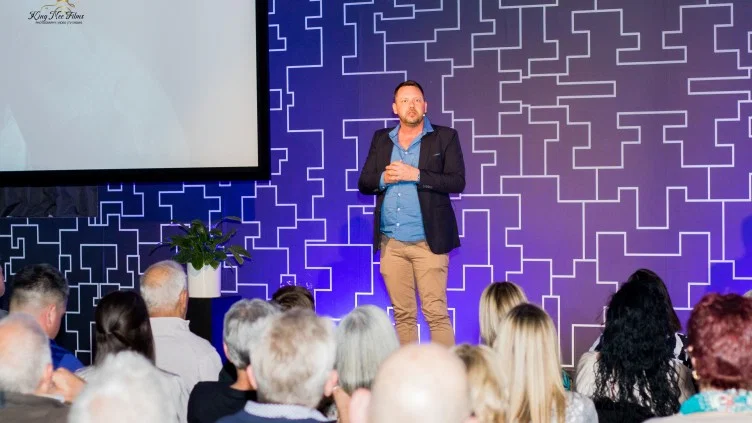
Stories that change how a room sees.
Bring Blind Inspiration to your stage.